Let’s be honest: beeswax candles are not cheap. If you’ve ever shopped for them and done a double-take at the price, you’re not alone. But once you understand what goes into making them, starting with the bees themselves, the price tag starts to make a lot more sense.
The Bees Do the Hardest Part
Have you ever actually thought about where beeswax comes from? Like, really thought about it? Bees have to make it, and making it costs them something real.
To produce one pound of beeswax, bees need to consume somewhere in the neighborhood of six to eight pounds of honey. They secrete the wax through glands on their abdomens as tiny flakes, then chew it and shape it into the comb. They build the very structure they use to raise brood and store honey, using material produced by their own bodies. It’s the most resource-intensive thing a hive produces.
There's no shortcut to real beeswax, and there's no good imitation either.
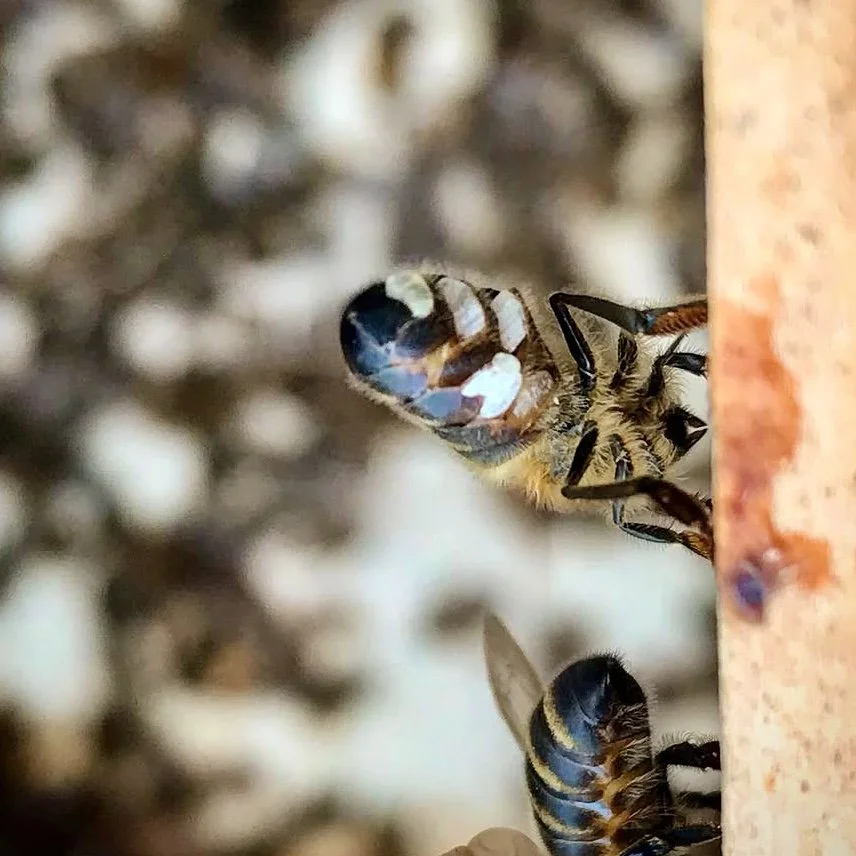
Can you even imagine how many of those tiny flakes are in one candle? It blows my mind.
From the Hive to Your Hands
At Rebels’ Roost, we keep top-bar hives, where bees build free-form comb without the pre-formed foundation used in conventional Langstroth box hives. When we harvest, we use the crush-and-strain method: the entire comb is crushed to release the honey, then strained. What’s left after the honey drains away is raw crushed wax, ready for processing.
From there, it goes into the solar melter. A solar melter is exactly what it sounds like: a box that uses the sun’s heat to gently melt the wax out of the comb, letting it separate from debris and flow into a collection vessel below. Just sun, time, and physics. It’s slow, and it’s worth it.
What comes out of the solar melter is a start, not a finish. Raw wax from the first melt is darker and contains plant material, propolis, and other hive residue. We then run it through several more rounds of filtering up in our honey room. Each pass produces cleaner, lighter, better-smelling wax until it’s ready to actually use.
Beeswax Burns Better
Not all candles are equal, and we’re not being snobby about it. There’s actual chemistry at work.
Paraffin is a petroleum byproduct. It’s cheap, it’s everywhere, and it produces soot. You’ve probably noticed it: the black marks on the glass jar, or the dark residue around a wick that’s burning too hot.
Beeswax burns cleaner. It has a higher melting point than most waxes, which means it burns slower and longer. It also releases negative ions when it burns (the same kind produced by moving water) which some people find genuinely calming. It has a subtle, natural scent that comes from the honey and propolis still present in the wax. No fragrance oils needed.
There’s also the light itself. Beeswax burns at a color temperature close to natural sunlight. It’s warm, full-spectrum, and easy on the eyes.
Our Candles: Tins and Molded
We currently make two styles of candle, and they’re built a little differently.
For our tinned candles, we use a custom blend of natural beeswax from our apiary and cocosoy wax (made from coconut and soy oils, not paraffin). Pure beeswax is incredible, but it can be notoriously difficult to burn cleanly in a container. The cocosoy wax ensures a wider, more even melt pool, allowing the flame to consistently reach the edges of the tin and prevent “tunneling”. This blend of waxes allows us to keep the integrity and subtle, natural scent of the pure farm beeswax, while delivering the cleanest, longest-lasting burn possible.
Molded candles are 100% pure beeswax with nothing added. Molded candles don’t have the same tunneling problem as container candles, which means pure beeswax can do exactly what it’s meant to do: burn slow, burn clean, and fill a room with that faint honey scent that’s impossible to fake. We’re expanding our molded candle line, so expect more shapes and sizes to come.
Getting the Most Out of Yours
A few things that make a real difference:
The first burn is everything. Beeswax has a memory. The first time you light your candle, let it burn long enough for the wax pool to reach the edge of the tin. This can take two to four hours for a wider tin, or approximately one hour for every inch diameter of the tin. If you cut it short, the candle will tunnel on every burn after that.
Trim your wick. Before each burn, trim it to about a quarter inch. A long wick means a bigger flame than the candle needs, which means more heat, more soot, and a shorter candle life. A quick pinch or snip before you light it goes a long way.
Stop at a quarter inch of wax. When you’re down to the last bit, stop burning. That last layer is there to protect the tin and whatever surface it’s sitting on from the heat of a wick burning against an almost-empty container.
Beeswax candles are one of those things where knowing the backstory makes the product better. Things made carefully, from real materials, by real animals on a real farm. That counts for something.
Browse our beeswax candles at rebelsroosthawaii.com/shop/beeswax-candles.